Best Arbitrage Betting Software for US Bookmakers 2026

Arbitrage betting software represents one of the most significant operational challenges facing modern sportsbooks and Pay Per Head providers in 2026. These sophisticated tools enable bettors to exploit pricing inefficiencies across multiple bookmakers, guaranteeing profit regardless of outcome. For operators managing sportsbook platforms, understanding how arbitrage betting software functions and implementing robust detection mechanisms is essential to protecting margins and maintaining sustainable business operations. This comprehensive analysis examines the operational impact of arbitrage tools, detection strategies, and how professional sportsbook platforms defend against systematic exploitation.
Understanding Arbitrage Betting Software: Operational Impact on Bookmakers
Arbitrage betting software automates the process of identifying pricing discrepancies across multiple sportsbooks, calculating optimal stake distribution, and executing trades before odds adjust. The technology has evolved dramatically from simple odds comparison websites to sophisticated algorithmic platforms that scan thousands of markets simultaneously.
How Modern Arbitrage Tools Operate
Today's arbitrage betting software employs several advanced techniques:
- Real-time odds aggregation from hundreds of bookmakers worldwide
- Automated calculation engines that identify profit opportunities within milliseconds
- Stake optimization algorithms that distribute wagers for guaranteed returns
- Multi-account management allowing simultaneous bet placement
- Mobile integration enabling rapid execution from any location
- Alert systems notifying users of fleeting opportunities
The speed advantage these platforms provide creates significant challenges for traditional bookmaking operations. According to research on structural characteristics of fixed-odds sports betting products, market inefficiencies exist primarily in lower-liquidity markets and rapidly changing live betting scenarios.
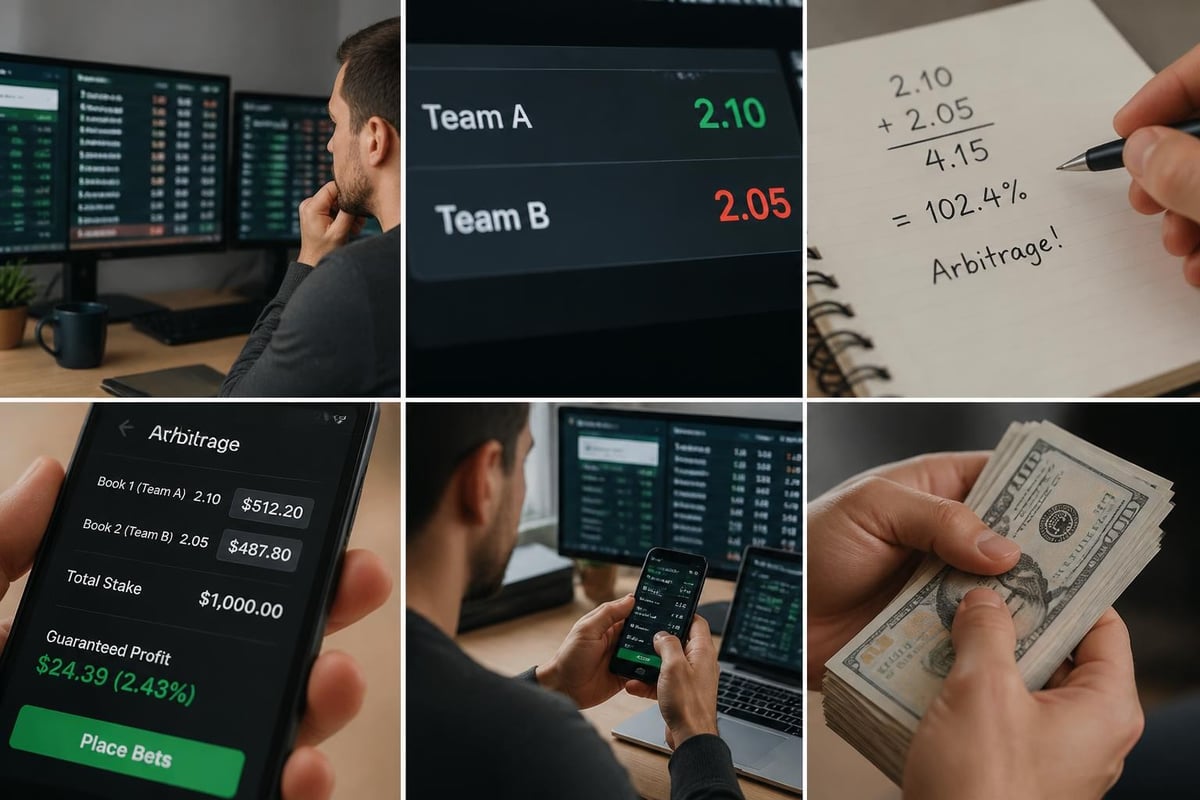
Professional arbitrage betting software typically focuses on specific market conditions where pricing discrepancies persist longest. These include newly posted lines before sharp money adjusts prices, niche sports with limited trading volume, and live betting markets where odds volatility increases during match play.
| Software Feature | Operational Impact | Detection Difficulty |
|---|---|---|
| Multi-book scanning | Exploits pricing variance | Medium |
| Automated execution | Reduces reaction time | High |
| Account rotation | Masks betting patterns | Very High |
| VPN integration | Obscures geographic location | High |
| Stake calculators | Optimizes profit margin | Low |
| Mobile deployment | Enables anywhere access | Medium |
Top Detection Strategies for Sportsbook Operators
Successful sportsbook solutions incorporate multiple layers of arbitrage detection and prevention. The most effective platforms combine pattern recognition, behavioral analysis, and real-time monitoring.
Best Overall Detection Approach: Behavioral Pattern Analysis
Behavioral pattern analysis examines betting history, stake sizing, market selection, and timing to identify systematic arbitrage activity. This comprehensive approach proves most effective because arbitrage bettors exhibit consistent patterns:
Pros:
- Catches sophisticated arbitrage operations
- Minimizes false positives
- Adapts to evolving tactics
- Provides actionable risk intelligence
Cons:
- Requires significant data infrastructure
- Demands ongoing algorithm refinement
- Higher implementation complexity
Best for: Mid-to-large sportsbooks processing 1,000+ daily wagers with diverse player bases requiring nuanced risk management.
Advanced sports betting software platforms now incorporate machine learning models trained on historical arbitrage patterns. These systems flag accounts demonstrating characteristic behaviors such as betting only positive expected value markets, consistent full-limit wagers, and activity concentrated during brief odds discrepancies.
Best Value Protection: Odds Velocity Monitoring
Odds velocity monitoring tracks how quickly individual accounts respond to newly posted lines or odds movements. Arbitrage betting software typically executes trades within seconds of price updates, creating distinct timing signatures.
Pros:
- Low computational overhead
- Easy to implement in existing systems
- Provides immediate flagging
- Minimal ongoing maintenance
Cons:
- May flag legitimate sharp bettors
- Less effective against slower arb strategies
- Requires complementary verification
Best for: Small-to-medium operators seeking cost-effective initial protection without extensive data science resources.
Best for High-Volume Operations: Multi-Book Correlation Analysis
Multi-book correlation analysis identifies when the same bettor (or coordinated group) places offsetting wagers across multiple platforms. This technique proves particularly valuable for operators managing multiple brands or participating in industry data-sharing arrangements.
The American Gaming Association's integrity monitoring framework highlights how regulated operators increasingly collaborate to detect patterns spanning multiple sportsbooks. While primarily focused on integrity concerns, these same detection mechanisms identify arbitrage activity.
Pros:
- Detects cross-platform arbitrage schemes
- Identifies coordinated betting rings
- Strengthens industry-wide defenses
- Provides competitive intelligence
Cons:
- Requires data-sharing partnerships
- Privacy and regulatory considerations
- Complex implementation across operators
Best for: Enterprise-level operations with multiple brands, extensive player databases, and established industry relationships.

Advanced Protection Mechanisms in Modern Sportsbook Platforms
Professional Pay Per Head sportsbook platforms integrate sophisticated risk management tools designed specifically to counter arbitrage betting software. These mechanisms operate at multiple levels within the betting infrastructure.
Account-Level Controls
Effective arbitrage protection begins with granular account management capabilities:
- Customizable betting limits adjustable in real-time based on risk assessment
- Delay mechanisms that introduce brief holds on bet acceptance for flagged accounts
- Market access restrictions limiting certain accounts to specific bet types
- Win/loss ratio monitoring tracking profitability patterns over time
- Deposit and withdrawal analysis identifying accounts with minimal risk exposure
Modern platforms allow operators to implement tiered response protocols. Rather than immediately limiting suspected arbitrage players, sophisticated operators may subtly reduce limits, introduce acceptance delays, or restrict access to vulnerable markets while maintaining the account relationship.
Market-Specific Protections
Different markets require tailored protection strategies. The UK Gambling Commission's guidance on in-play betting addresses automated trading and emphasizes operators' responsibilities for detecting and managing systematic exploitation, particularly in live wagering environments.
High-Risk Markets:
- Niche sports with limited global liquidity
- Proposition bets with specialized knowledge edges
- Live betting during volatile match situations
- New or experimental bet types
Protection Tactics by Market Type:
| Market Category | Primary Vulnerability | Recommended Protection |
|---|---|---|
| Live betting | Rapid odds movement | Acceptance delays, reduced limits |
| Low-liquidity sports | Limited price discovery | Conservative maximum stakes |
| Props and specials | Information asymmetry | Enhanced verification, lower exposure |
| Futures markets | Long-term price shifts | Position monitoring, dynamic limits |
| Parlays and combos | Correlated outcomes | Automated correlation detection |
Technology Infrastructure Requirements
Implementing comprehensive arbitrage protection demands robust technical infrastructure. Leading sportsbook software providers build their platforms on real-time data processing architectures capable of analyzing betting patterns as they occur.
Essential technical components include:
- Sub-second data processing for real-time pattern recognition
- Historical database architecture supporting complex behavioral queries
- API integration capabilities for third-party risk management tools
- Automated alert systems notifying risk managers of suspicious activity
- Reporting dashboards visualizing account behavior and risk exposure
- Flexible rule engines enabling custom detection logic without code changes
Regulatory and Operational Considerations for US Bookmakers
The regulatory landscape significantly impacts how operators address arbitrage betting software. Different jurisdictions maintain varying perspectives on arbitrage activity, from treating it as legitimate market efficiency to classifying it as terms-of-service violations warranting account closure.
Compliance Framework Integration
Regulated sports betting operations must balance arbitrage protection with player rights, transparency requirements, and responsible gaming obligations. Overly aggressive limiting practices may attract regulatory scrutiny, while insufficient protection erodes profitability.
Best practices for compliance-conscious arbitrage management:
- Clear terms of service explicitly addressing automated betting tools and multi-account usage
- Documented decision protocols for account restrictions and closures
- Player communication standards explaining limitation decisions when requested
- Appeal mechanisms allowing players to contest restrictions
- Regular compliance audits ensuring detection systems don't inadvertently discriminate
- Responsible gaming integration distinguishing arbitrage activity from problem gambling patterns
Economic Impact on Sportsbook Operations
Understanding the financial implications of arbitrage betting software helps operators prioritize protection investments. Research comparing financial and gambling markets demonstrates that sports betting arbitrage opportunities typically yield 1-5% returns when successfully executed, with most opportunities existing for brief windows.
For sportsbooks, the impact manifests several ways:
Direct costs:
- Margin erosion on exploited markets
- Increased hedging expenses to manage exposure
- Technology investment in detection systems
- Personnel costs for risk management teams
Indirect costs:
- Reduced pricing aggressiveness to minimize vulnerabilities
- Lost recreational player volume due to conservative odds
- Reputational impact from perceived "sharp unfriendly" policies
- Competitive disadvantage in player acquisition

Strategic operators recognize that some level of arbitrage activity indicates competitive pricing and market efficiency. The goal becomes managing exposure to acceptable levels rather than attempting complete elimination, which would require odds so conservative that recreational players migrate to more generous competitors.
Implementation Roadmap for Arbitrage Protection Systems
Deploying effective arbitrage defenses requires systematic implementation aligned with operational capacity and business objectives. Professional sportsbook platforms provide the foundation, but successful protection demands strategic planning and ongoing refinement.
Phase 1: Foundation (Weeks 1-4)
Establish baseline protection capabilities:
- Audit current detection capabilities identifying existing tools and gaps
- Define risk tolerance thresholds establishing acceptable exposure levels
- Implement basic monitoring tracking bet sizing, timing, and market selection patterns
- Document current arbitrage impact measuring baseline profitability erosion
- Train risk management staff ensuring team understands arbitrage mechanics
Phase 2: Enhancement (Weeks 5-12)
Build sophisticated detection and response mechanisms:
- Deploy behavioral analysis algorithms implementing pattern recognition systems
- Integrate multi-account detection identifying related player accounts
- Establish tiered response protocols creating graduated limitation procedures
- Implement automated alerts enabling real-time risk team notifications
- Create reporting dashboards visualizing arbitrage activity and trends
Phase 3: Optimization (Ongoing)
Continuously refine protection effectiveness:
- Monthly performance reviews analyzing detection accuracy and false positive rates
- Quarterly algorithm updates incorporating new arbitrage tactics and patterns
- Competitive benchmarking assessing protection effectiveness versus market standards
- Player feedback integration understanding legitimate player concerns about limitations
- Technology stack evaluation considering new tools and platform capabilities
Resource Allocation by Operation Size
| Operation Size | Monthly Arb Impact | Recommended Investment | Expected ROI Timeline |
|---|---|---|---|
| Small (0-500 active players) | $500-2,000 | Basic monitoring tools | 6-9 months |
| Medium (500-2,500 players) | $2,000-10,000 | Dedicated risk staff + software | 3-6 months |
| Large (2,500-10,000 players) | $10,000-50,000 | Full risk team + advanced platform | 2-4 months |
| Enterprise (10,000+ players) | $50,000+ | Comprehensive detection suite | 1-3 months |
Integration with Comprehensive Risk Management
Arbitrage betting software represents just one component of comprehensive sportsbook risk management. The most effective operators integrate arbitrage detection within broader risk frameworks addressing sharp betting, bonus abuse, and fraud prevention.
Holistic Risk Architecture
Modern betting solutions approach risk management as interconnected systems rather than isolated challenges. Arbitrage detection shares infrastructure and intelligence with:
- Sharp player management identifying consistently profitable bettors regardless of strategy
- Bonus abuse prevention detecting promotional exploitation and account farming
- Fraud detection recognizing stolen accounts, payment fraud, and identity theft
- Integrity monitoring flagging suspicious betting patterns indicating match manipulation
- Responsible gaming controls identifying problem gambling behaviors requiring intervention
This integrated approach maximizes technology investment efficiency while providing comprehensive operational protection. The same behavioral analysis algorithms identifying arbitrage activity simultaneously detect other risk categories, multiplying the return on detection system investment.
Building a Risk-Aware Culture
Technology alone cannot effectively counter arbitrage betting software. Successful operations cultivate risk awareness throughout their organizations:
- Cross-functional training ensuring customer service, marketing, and technical teams understand risk implications
- Incentive alignment balancing player acquisition goals with risk management objectives
- Regular strategy sessions reviewing emerging threats and protection effectiveness
- Industry participation engaging with peers to understand evolving arbitrage tactics
- Continuous education staying current with arbitrage technology developments
Organizations that embed risk thinking across departments respond more effectively to arbitrage challenges while maintaining positive player relationships and competitive market positioning.
Technology Partner Selection Criteria
Choosing the right sportsbook software platform significantly impacts arbitrage protection capabilities. Operators evaluating technology partners should prioritize specific features and support characteristics.
Essential Platform Capabilities
Must-have features:
- Real-time bet monitoring with configurable alert thresholds
- Comprehensive player history accessible during bet review
- Flexible limiting and restriction tools
- Automated pattern recognition algorithms
- Detailed reporting and analytics dashboards
- API access for third-party risk tool integration
Valuable advanced features:
- Machine learning-based behavioral analysis
- Cross-platform player correlation
- Predictive risk scoring
- Automated response execution
- Mobile-optimized risk management interfaces
- Customizable detection rule engines
Vendor Support and Partnership
Beyond technology features, effective vendor relationships provide ongoing value:
- Proactive threat intelligence alerting operators to emerging arbitrage tactics
- Regular platform updates incorporating new detection capabilities
- Responsive technical support resolving issues impacting risk management
- Training and education helping staff maximize platform capabilities
- Strategic consultation advising on risk management best practices
- Industry networking connecting operators with peers facing similar challenges
Leading providers like PerHead Kings differentiate themselves through comprehensive support ecosystems that extend beyond basic platform functionality, delivering strategic partnership that evolves with operator needs and market conditions.
Effective arbitrage protection balances sophisticated detection with sustainable player relationships and operational efficiency. Modern bookmakers recognize that arbitrage betting software challenges demand comprehensive technology platforms, skilled risk management teams, and strategic operational approaches. PerHead Kings delivers the advanced sportsbook technology, real-time risk management tools, and expert support that bookmakers and agents need to protect margins while maintaining competitive offerings. Explore how our comprehensive Pay Per Head solutions can strengthen your operation's defenses against systematic exploitation while supporting sustainable growth.
More Articles
Get the insight into the trending topics and latest action in the industry.



Sign Up Now
This is the day your business becomes elite!